Shaman / Nahual
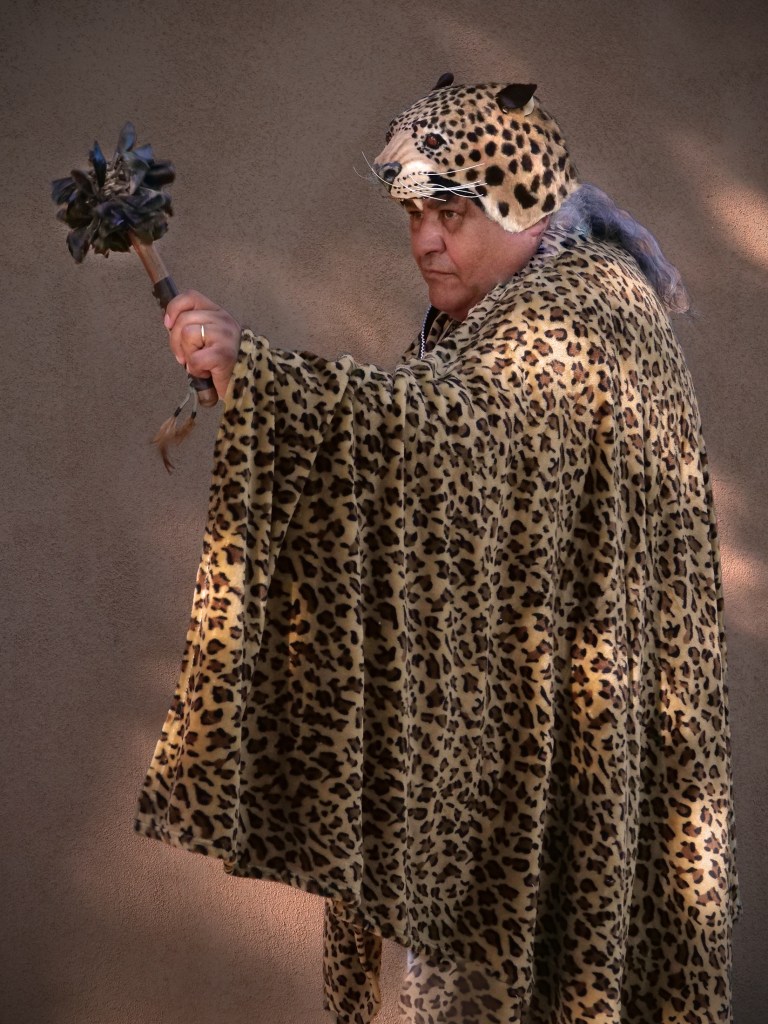
AAdrian Rivera works in the tradition of the Shaman, also known as Nahual in Mexico. The word Shaman comes from the Asian continent, more specifically parts of Russia, Mongolia and China, but in Mexico, a lot of people have an affinity for the term. Some scholars argue that shamans from the Mexican tradition should adopt the term Nahual to honor their Mexican ancestry. Others argue that shaman has become such a recognized term that it can be applied to any culture around the world.
In his book, Shaman Awakening of the Natural Secret, AAdrian Rivera offers a definition for shaman: a wise person in the context of a tribe, family, or society usually regarded as a figure of authority on supernatural topics and spirituality. Abilities associated with Shamans include: bridging the physical and spiritual worlds, understanding our relationship with animals, perceiving supernatural messages about natural disasters, communicating with spiritual beings and helping people heal.
An article in the edition number 90 of the magazine Mexicanisimo analyzes the Nahual, the Mexican version of the shaman. The authors Ivan Perez Tellez and Carlos Heiras Rodriguez present the nahual in a similar way to Adrian’s definition of the shaman but in the context of indigenous Mexican populations. The nahual serves as a bridge between humans, anthropomorphic beings and animals. The nahual also explores the relationship between humans, animals and natural phenomena like thunder, winds and meteors. Like the shaman, the nahual can also be a protector of the community and a healer.
AAdrian Rivera is originally from the Chihuahua, Mexico and has American Indigenous ancestry on his father’s side. His mother has French and Mexican lineages. In his practice he uses various outfits, rattles, feathers, drums and sacred objects referencing animals.
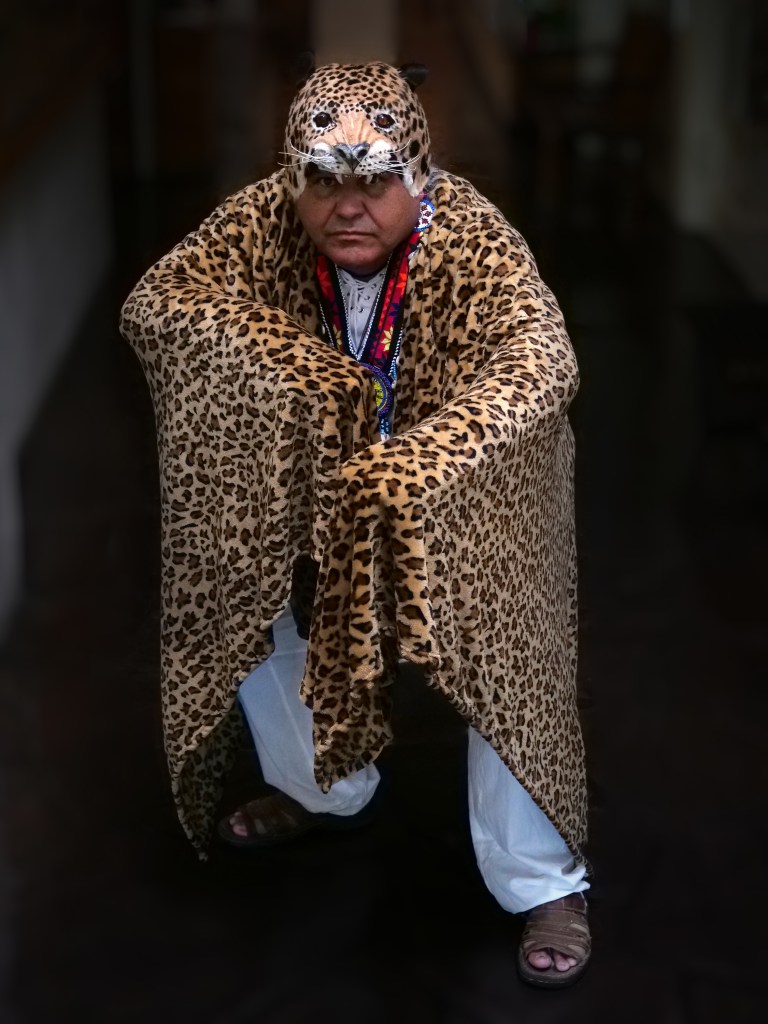
In June of 2024, I participated in a group meditation led by AAdrian called Shamanic Journey. The meditation was held outdoors in a grassy area. There were about 12 other participants. Before we started, AAdrian instructed us to be in control of our mind and to set an intention. He suggested that we meditate about our past and look for answers for unresolved issues. Those who experienced uncomfortable sensations or memories had the chance to stop the practice.
We laid our bodies on the grass facing up, closed our eyes and began looking into our past experiences. Throughout the practice, AAdrian was beating on an a sacred drum consistently for 15 minutes or more. The consistent beat of the drum had a hypnotizing effect which helped me enter a mental state where my normal sense of time and space changed. I recalled memories of my life in a non-chronological order. They were like fragments of life that came in and out quickly in my head. Although I did not see any specific messages, the Shamanic Journey helped me relax the mind. It also helped me appreciate life more.
One female participant reported that she saw a particular unresolved trauma in her life. She recounted that she saw the lady with whom her husband had been unfaithful. She visualized a specific incident where she entered a hotel room and found her husband with the woman. The exercise allowed her to talk about her trauma. It allow her to reflect on the incident. She mentioned that during her marriage she had been too busy with things other than her relationship to her husband. She felt partly responsible for her marriage falling apart.
Quiropráctico (chiropractor) or huesero
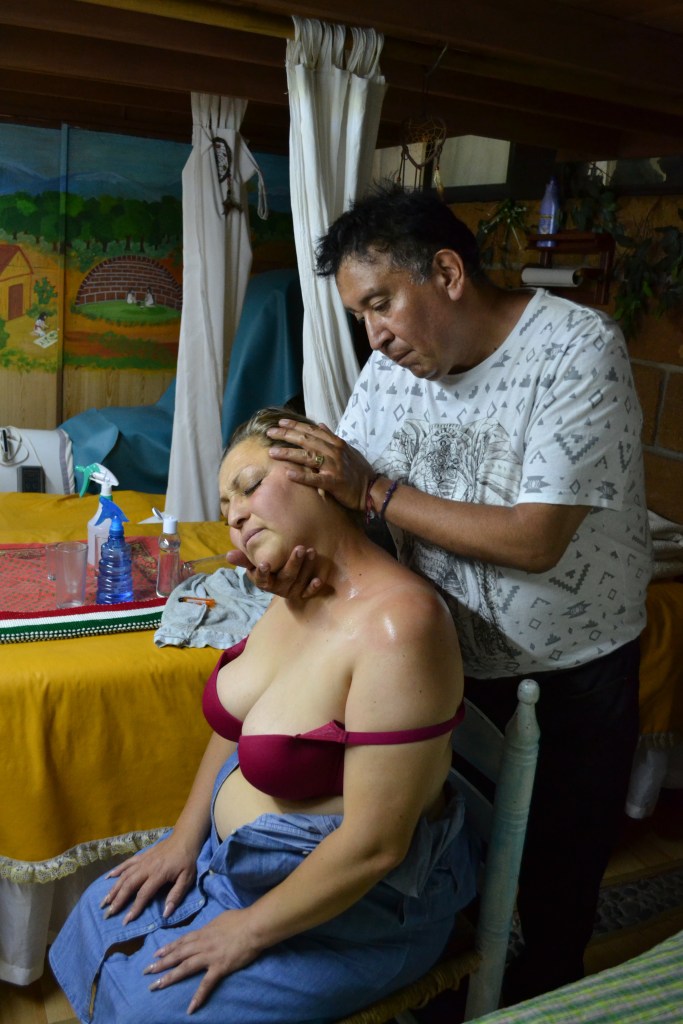
In Mexico City, Agustin Perez is considered a huesero or bone setter. Hueseros are traditional or ancestral healers who deal with bone and ligament issues by setting them back in place according to an article in the Na’atik Language and Culture Institute.
The huesero tradition can be considered a form of chiropractic work. Both deal with the nervous and musculoskeletal systems. Agustin also uses fire cupping and massage therapy. In Spanish, massage is also known as masoterapia.
People often come to Agustin with sciatic nerve, hip, neck, back, shoulder, knee and ankle problems to his clinic in Mexico City. When I visited his clinic in 2022, I noticed that it does not have signs or advertisements. Instead, his practice relies on word of mouth. It appears that people learn about Agustin’s clinic through recommendations.
Agustin has practiced these huesero traditions for more than 25 years. He was taught by his father and grandfather and his story exemplifies the concept that Curanderismo is passed down informally through ancestors.
 Curandero Project
Leave a comment