The healing traditions found in Curanderismo come from a variety of sources. In her book entitled Woman Who Glows in the Dark, Elena Avila explains that the encounter between Europeans, Indians, Africans started a series of multicultural exchanges that gave rise of Curanderismo. Their offspring, which are often called mestizos or mulatos, carried on this legacy of blending multiple perspectives and practices.
The Europeans that Elena Avila identifies in her book are the Spaniards. When they arrived in Mexico in the fifteen hundreds, they encountered a civilization that they called the Aztecs. The Aztecs in turn referred to themselves as the Mexihka or Mexica.
The Mexihka had a complex civilization and vast knowledge of medicinal plants. Evidence for this is the existence of a Mexhika treatise named Codice de la Cruz-Badiano. It was written by an indigenous doctor by the name of Martin de la Cruz. The book describes in detail the types of flower, plants, trees and ingredients used in Mexhika medicine.
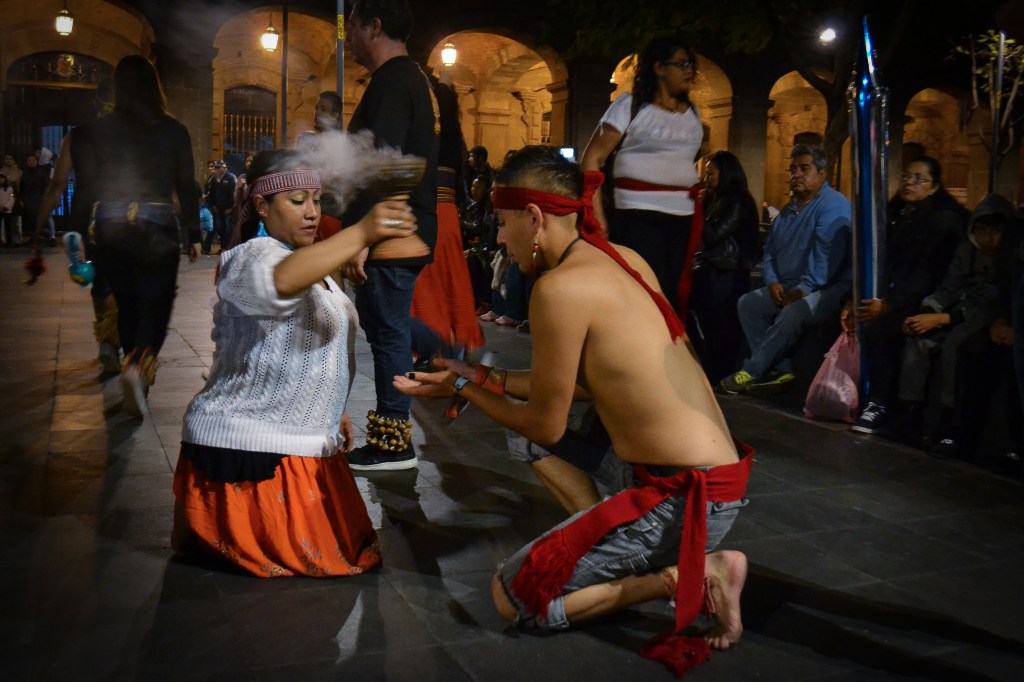
Elena Avila also explains that Mexihka medicine was highly spiritual and sacred forces were used in treatments and diagnosis. We can see a glimpse of this in the above image. Mexhika style dancers at Mexico City’s main square known as Zocalo, dance for several hours to the beat of a drum in a coordinated fashion. Participants wear rattles around the ankles known as ayoyotes in Nahuatl creating a high energy sound effect.
These types of dancers are often rerrered to as danzantes mexhikas or concheros. In this image, a woman spreads smoke of copal (tree resin) on a dancer before he joins the dance group. In Curanderismo, smoke of copal is widely used in prayers and rituals. It said to create a connection between the physical and the spiritual worlds in addition to purifying the energy of a person.
Through the dance, practitioners connect with nature, ancestors, and sacred forces believed to have been used by the Aztecs before the arrival of the Spaniards. The use of copal is an ancient tradition in Mexico dating back to pre-Hispanic societies.

Curanderismo also has roots in the traditions brought by the Spaniards to the Americas. Perhaps the most obvious one is the introduction of Judeo-Christian beliefs.
In his book, Healing with Herbs and Rituals, Eliseo “Cheo” Torres points out a recurring concept in Curanderismo, which is that all power to heal from God.
Roman Catholicism, the most dominant religion brought to Mexico by the Spaniards has influenced many of the healing practices of Curanderismo. Practitioners often display images of Jesus on the cross, the Sacred Heart, saints, the Virgin of Guadalupe, and the archangels in their practices.
Many practitioners of Curanderismo often say that they do not heal people, instead they credit God or The Creator as the source of healing. They often refer to themselves as conduits for healing while some prefer the word facilitator.
According to Elena Avila, the Spaniards also introduced into Curanderismo the concept that an illness can be linked to evil forces, hexes, curses, and punishment for sins for not following God’s commands.
In the above image, the late Maclovia Sanchez de Zamora also known as Doña Maclovia stands inside an herb store carrying a variety of sacred Catholic images. She was a well known herbalist and advisor in Albuquerque, New Mexico. Her herb store or yerberia in Spanish was known as B. Ruppe Drugs. She worked there until her death in 2017.
Because of its location on the Mediterranean sea, the region of present day Spain was influenced by a many of groups of people throughout history. Several ports served as points of arrival and departure for traders, explorers and invaders. In his book Espejo Enterrado, renown Mexican scholar Carlos Fuentes summarizes this story.
As a result of this multicultural history, the Spaniards introduced more than just Judeo-Christian religious traditions to Mexico.
In his book Healing with Herbs and Rituals, author Eliseo “Cheo” Torres states that the theory of “the humors” in Curanderismo came from the Moors.
The Moors were a group of North African Muslims who captured Southern Spain between 711 and 1492 and established an empire called Al-Andalus.
The Moors revived the theory of the Humors in the Southern Spain which was first introduced by Hippocrates, a Greek physician.
According to Eliseo “Cheo” Torres:
“the theory of the humors presumes that there are four liquids in the human body: blood, phlegm, yellow bile, and black bile.”
Each liquid has its own qualities such as hot, cold, moist and dry. When there is an imbalance of the humors, physical ailments will manifest in a person.
When the Spaniards arrived in the Americas, they imported this theory of the humors, which eventually made its way into Curanderismo.
Arabic was the primary language of the Moors in Al-Andalus and for over 7 centuries it made a lasting impact on the Spanish language. According to Carlos Fuentes, about a fourth of the Spanish vocabulary is rooted in Arabic. Perhaps one of the most common examples of this is the word ojala, which is heavily used in Mexico. It comes from the Islamic expression Inshallah meaning “God willing”.
Another example of the Moorish influence in Mexico is the use of the flor de azahar or the orange blossom. The orange tree is not native to Mexico, it was introduced to by the Spaniards. Orange trees have played an important role in Southern Spain dating back to many centuries. Sevilla, a city that was heavily influenced by the Moors and Islam, considers the orange tree an integral part of its culture and history.
In Al-Andalus, flower crowns made of orange blossoms were worn by brides to symbolize, eternal love, fidelity and purity. In Mexico, orange blossoms have also been worn by brides as it is evident in the song Llorar by Los Socios del Ritmo. The song tells the story of a man who sees his former girlfriend enter a wedding chapel to marry another man. The bride is wearing orange blossoms.
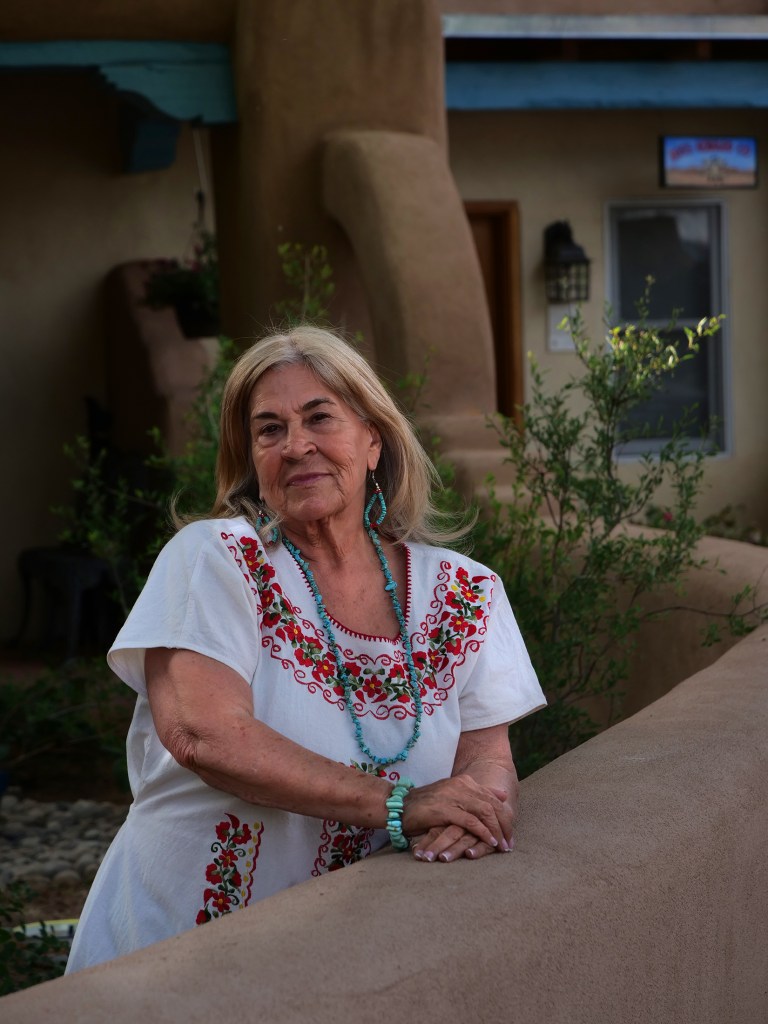
In the above image, a northern New Mexican healer named Cecilia Martinez Howard stands in front of her house. She traces a great part of her ancestry to the Spaniards that came to New Mexico in the 18th century.
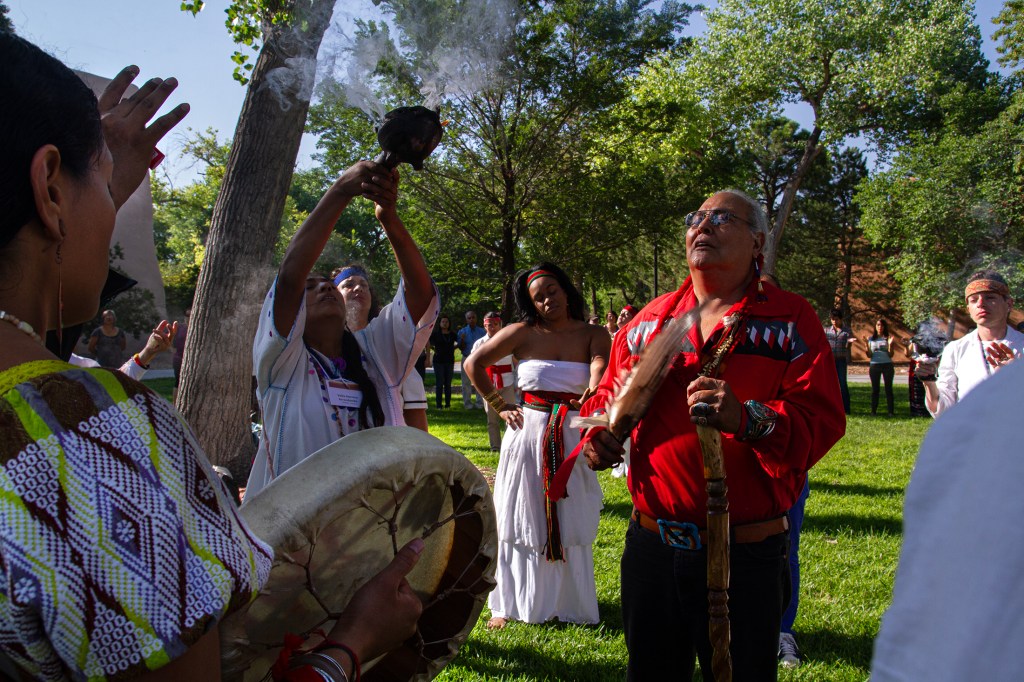
According to Elena Avila, millions of Africans came to America and Mexico between 1500 and 1870.
Cuba for example, has a rich African heritage. Mexico and Cuba share a similar Spanish past. Cuba was an important first stop in the American continent for Spanish sailors on their way to Mexico as described in the Chronicle of the Narvaez Expedition by Alvar Nunez Cabeza de Vaca.
Generally speaking, the African perspective on healing shares many things in common with those of Native cultures of the Americas.
Africa is a vast land with plenty of diversity so it not a monolith just like Curanderismo. But when it comes to identifying regions of Africa with the greatest connection to Curanderismo, West Africa makes the most sense due to its geographical position. The West African coast is the closes point of departure from the continent to the Americas. During the transatlantic slave trade, many people native to West Africa were forcefully sent to the Americas.
An excerpt from Elena Avila’s book compares the practices of both West Africans and Native Americans. Both practiced
“an earth-oriented spirituality, that saw the world as alive and inhabited by spiritual energies with which they could interact through ceremony, offerings, and prayer. Both saw soul and spirit not as something holy and disconnected from the body, as the Spaniards did, but as inside of us, grounded in our physical body, emotions and mind.”
 Curandero Project
Leave a comment